Key Takeaways
- Modern waterproof laminate with an HDF or WPC core is conditionally compatible with radiant floor heating, but that compatibility depends entirely on respecting the manufacturer's published surface temperature ceiling, typically 80 to 85 degrees Fahrenheit, and never operating the system above it.
- Hydronic (water-based) radiant systems are generally safer for laminate than electric resistance systems because hydronic heat rises and stabilizes gradually. Electric systems can spike surface temperatures quickly, which increases the risk of core expansion and joint stress in laminate planks.
- The extreme cold of an Aurora winter creates a specific risk: a radiant system pushed to compensate for poor envelope insulation will run hotter and longer than a well-insulated home's system, making temperature control more critical, not less.
- Warranty compliance is not automatic. Many laminate manufacturers require written documentation that a radiant system meets their temperature specifications before any warranty claim involving the floor will be honored. Verifying this before installation protects the investment.
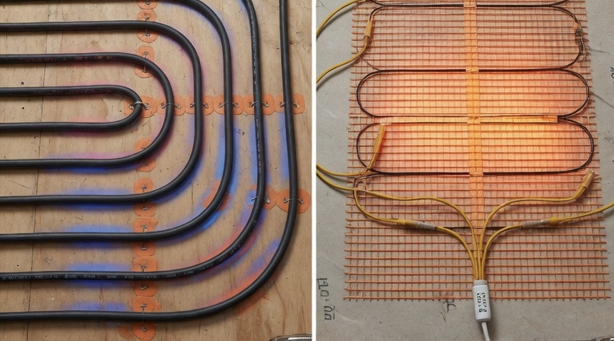
What exactly is radiant floor heating, and what are the two main system types?
Radiant floor heating delivers warmth by raising the temperature of the floor surface itself, which then radiates heat upward into the room. Unlike forced-air systems that heat the air directly, radiant systems heat objects and people through infrared radiation and conduction. The result is a floor that is warm to the touch and a room that feels evenly heated from the ground up rather than from a ceiling vent downward.
The two system types differ in how they generate that heat, and the distinction matters for laminate compatibility.
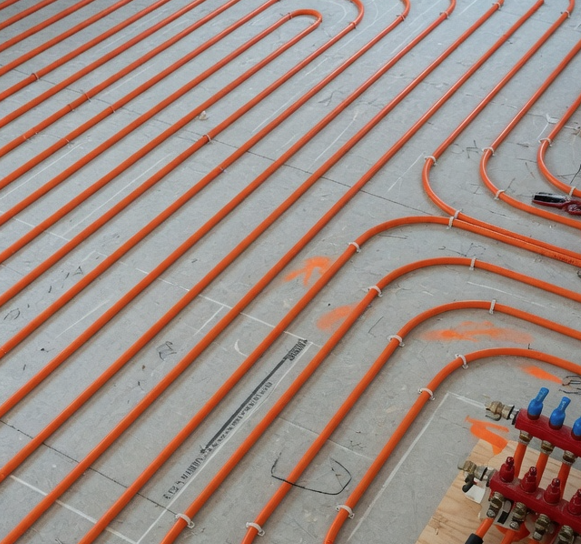
Hydronic radiant systems: circulate warm water through a network of tubing embedded in or below the floor assembly. A boiler or heat pump heats the water, which travels through the tubing loops and transfers heat into the subfloor and floor covering above. Hydronic systems heat slowly and hold temperature steadily. Once the system reaches operating temperature, surface fluctuations are modest. That gradual, stable heat profile is more forgiving for laminate and other wood-based products than sudden temperature spikes.
Electric radiant systems: use resistance heating cables or mats installed beneath the floor covering. They respond to thermostats faster than hydronic systems and are more common in retrofit installations where running new water tubing through an existing home is impractical. The trade-off is that electric systems can heat up quickly and, if a thermostat malfunctions or is set incorrectly, can push surface temperatures beyond what laminate tolerates before the homeowner notices. For laminate specifically, a programmable thermostat with a floor-sensing probe, not just an air-sensing probe, is a critical safeguard with an electric system.
What does 'waterproof laminate' actually mean, and does that waterproofing help with radiant heat?
The waterproof designation on modern laminate refers primarily to the core material's resistance to moisture swelling, not to heat tolerance. Standard laminate uses a high-density fiberboard (HDF) core that swells noticeably when exposed to water. Waterproof laminate uses either a modified HDF with a tighter, denser fiber structure and sealed edges, or a wood-plastic composite (WPC) core that incorporates polymer materials to reduce moisture absorption dramatically.
That moisture resistance is genuinely relevant to radiant heat, but not in the way most homeowners assume. The relevance is indirect: a well-sealed, moisture-resistant core is less likely to absorb humidity changes that accompany heating cycles. When a radiant system heats a room aggressively during an Illinois winter, indoor relative humidity drops as warm air holds less moisture relative to its temperature. A standard HDF core can dry out, contract, and develop gaps at joints under those conditions. A waterproof core with better dimensional stability handles those humidity fluctuations with less movement.
However, waterproof laminate is not heat-proof laminate. The resins and adhesives bonding the laminate layers together have temperature limits. The decorative layer and wear layer above the core can also be affected by sustained heat above the manufacturer's ceiling. Waterproof simply means the product handles liquid water better than standard laminate. It does not mean the product is rated for unlimited heat exposure.
What surface temperature limits apply to laminate over radiant systems, and why do they matter?
Most laminate manufacturers publish a maximum allowable floor surface temperature in their installation guidelines and warranty documentation. That number typically falls between 80 and 85 degrees Fahrenheit (27 to 29 degrees Celsius) for waterproof and premium laminate products. Some manufacturers specify 77 degrees Fahrenheit (25 degrees Celsius) for standard HDF-core products.
Those limits are not conservative suggestions. They reflect the temperature at which the adhesive layers within the laminate plank begin to soften and the locking joint geometry can be affected by thermal expansion in the core. Above the limit, the core expands more than the locking system was engineered to accommodate. Over repeated heating and cooling cycles, that stress accumulates. The first visible sign is usually a slight cupping at the center of planks, followed by joint separation or peaking at seams in the worst-affected areas.
The practical implication for an Aurora home is this: a radiant system that must work hard to heat a room because of inadequate insulation, single-pane windows, or a leaky building envelope will run at higher temperatures and for longer periods than a well-insulated home's system. If the system is pushing the subfloor to 90 degrees to achieve a comfortable air temperature, the laminate above is being operated outside its rated range even if the air temperature in the room feels normal.
A floor-sensing thermostat probe addresses this directly. The probe reads actual surface temperature rather than air temperature, and it cuts power to the system when the surface reaches the set limit. For laminate over a radiant system, this is a practical safeguard rather than an optional accessory.
How does Aurora's climate specifically stress laminate installed over radiant heating?
The Chicago-area climate creates a specific combination of stresses that homeowners in milder regions do not face at the same intensity.
January and February bring sustained cold that drives radiant systems to run longer and at higher output than they would in a moderate winter. A system that cycles on for 20 minutes per hour in October may run nearly continuously in January. That continuous operation raises subfloor and surface temperatures higher than brief cycling would, and it reduces the recovery time between heat cycles that allows the floor material to re-equilibrate.
Simultaneously, forced-air heating combined with radiant heating in the same home, a common configuration in Aurora subdivisions where radiant was added to supplement an existing HVAC system, can drive indoor relative humidity to 20 percent or below during cold stretches. At that humidity level, wood-based cores lose moisture and contract. The combination of heat-driven expansion in one direction and dryness-driven contraction in another creates competing stresses in the laminate plank that eventually manifest as joint gapping or surface cracking in the wear layer.
A whole-home humidifier set to maintain indoor relative humidity between 35 and 50 percent during winter is not a comfort luxury in this context. For any wood-based flooring product over a radiant system in an Illinois home, it is a practical measure that directly extends the floor's service life and reduces the risk of thermally and humidity-driven damage.
How does waterproof laminate compare to other flooring types for use over radiant heating?
The table below covers the flooring types most commonly considered for radiant heat installations in Aurora-area homes. Maximum surface temperature values are general industry guidelines; always verify the specific product's published specification before installation, as individual manufacturer limits vary.
| Flooring Type | Max Surface Temp | Radiant Compatibility | Stability Risk | Verdict |
|---|---|---|---|---|
| Waterproof Laminate (modern HDF/WPC core) | 80-85 F (27-29 C) | Good with hydronic; moderate with electric | Low to moderate if temp limits respected | Suitable with precautions |
| Standard Laminate (HDF, no waterproof core) | 75-80 F (24-27 C) | Limited; manufacturer restrictions common | Moderate to high; edges can lift | Use with caution; verify warranty |
| Luxury Vinyl Plank (LVP/SPC core) | 80-85 F (27-29 C) | Very good; SPC core dimensionally stable | Low; SPC resists thermal movement | Reliable choice for radiant |
| Engineered Hardwood | 80-82 F (27-28 C) | Good; cross-ply core handles cycles well | Low to moderate; veneer can dry | Suitable; maintain humidity above 35% |
| Solid Hardwood | Not recommended | Poor; expands and contracts excessively | High; cupping, gapping, warping likely | Avoid over radiant systems |
| Porcelain / Ceramic Tile | No limit practical | Excellent; ideal radiant partner | Very low | Preferred for radiant efficiency |
| Cork Flooring | 75 F (24 C) max | Poor; insulates against heat output | Low structurally but defeats system purpose | Not recommended over radiant |
Note: Compatibility ratings assume a properly installed, calibrated radiant system with a floor-sensing thermostat. Systems without surface temperature control, or systems operated above published limits, can damage any flooring type including those rated as suitable.
What does a correct installation look like when putting waterproof laminate over a radiant system?
A reliable installation sequence for this combination:
- Verify the radiant system is fully commissioned and has been operating for at least 30 days before any flooring goes down. New hydronic systems especially need time to cure the substrate and stabilize moisture levels in the subfloor assembly.
- Run the radiant system through a pre-conditioning cycle before installation: raise the surface temperature to the planned operating range, hold it for 48 hours, then reduce to room temperature and hold for another 24 hours. This cycle drives residual moisture out of the subfloor and allows any initial expansion and contraction to occur before the flooring is present.
- Turn the radiant system off and allow the surface to cool to room temperature (65 to 70 degrees Fahrenheit) before beginning installation. Laminate should not be installed on a warm subfloor because the planks will be in an expanded state and will contract as they cool, pulling joints apart.
- Acclimate the laminate in the installation room for a minimum of 48 hours with the radiant system off. The room temperature and humidity during acclimation should match expected living conditions, not the elevated temperature of an active radiant system.
- Install with the expansion gap recommended by the manufacturer, typically 3/8 to 1/2 inch at all walls and fixed objects. Radiant-heated laminate needs this gap more, not less, than standard installations because the thermal cycling creates additional expansion and contraction demands beyond normal seasonal movement.
- Do not install rubber-backed area rugs over laminate on a radiant system. Rubber backing traps heat beneath the rug, creating a localized hot spot that can push the surface temperature above the manufacturer's limit in that area even when the rest of the floor is within range.
- After installation, restart the radiant system gradually. Increase the thermostat setting by no more than 3 to 5 degrees per day over the first week, allowing the floor to adjust incrementally rather than subjecting it to a full-temperature shock on day one.
What underlayment is appropriate for laminate installed over radiant heating?
Underlayment selection for laminate over radiant heating involves a direct trade-off: the properties that make underlayment good at sound reduction (thickness, density, insulating quality) work against radiant heat transfer efficiency.
A thick, dense acoustic underlayment acts as a thermal barrier. It reduces the amount of heat that reaches the floor surface from the radiant system below, which forces the system to run at higher temperatures or for longer periods to achieve the same surface warmth. That defeats part of the purpose of radiant heating and, for laminate, pushes the system toward higher operating temperatures that stress the floor.
For laminate over radiant heat, the general guidance is to use the thinnest underlayment compatible with the flooring manufacturer's warranty, typically 1 to 2mm, with a thermal resistance (R-value) no greater than 0.5. Many laminate manufacturers specify a maximum R-value for underlayment used with radiant systems in their installation documentation. Exceeding that R-value is a warranty exclusion in most cases.
If the laminate product has an attached underlayment pad, check whether the manufacturer rates that specific product for radiant heat use. Some attached-pad laminates are not approved for radiant applications because the pad's thermal resistance exceeds the allowable limit. Removing an attached pad is not practical; in those cases, a different flooring product is the correct choice.
For moisture control over a concrete subfloor with a hydronic radiant system embedded in the slab, a thin vapor barrier rated for radiant applications is appropriate. Standard 6-mil poly sheeting used as a vapor barrier adds minimal thermal resistance and is compatible with most manufacturer specifications.
What warranty issues should a homeowner anticipate when combining laminate with radiant heat?
Warranty coverage for laminate over radiant heating is more conditional than most homeowners expect, and the conditions are worth reading carefully before purchase rather than after a problem appears.
- Most laminate warranties that permit radiant heat use require that the system be a hydronic type or a low-wattage electric mat, not a high-output electric cable system. Verify the system type matches what the warranty allows.
- Temperature compliance is the most common warranty exclusion. If a claim involves flooring damage and the manufacturer's service representative determines the system operated above the published surface temperature limit, the claim is typically denied regardless of other circumstances. A floor-sensing thermostat with a logged temperature record provides documentation that the system was operated correctly, which strengthens any future warranty position.
- Underlayment R-value violations are another frequent exclusion. If the installed underlayment has a higher thermal resistance than the warranty permits, coverage for heat-related damage is voided. Keep the underlayment product specification sheet as part of the installation documentation.
- Some manufacturers require that the radiant system installation be performed by a licensed contractor and that the flooring installation be performed by a certified installer for the warranty to apply in a radiant heat context. Homeowner-installed flooring over a DIY radiant system may not carry the same coverage as a professionally installed assembly.
- The warranty period for laminate used over radiant heating is sometimes shorter than the standard warranty for the same product installed without radiant heat. Read the specific radiant-use clause in the warranty document rather than relying on the headline warranty duration advertised on the packaging.
Are there situations where a different flooring product is the more practical choice over radiant heating?
Yes, and being direct about this is more useful than suggesting laminate works in every radiant heat context.
If the radiant system is the primary heat source for a room, particularly a basement or a room with significant heat loss, the system will need to operate at or near its maximum output during cold months. In that scenario, the margin between normal operating temperature and the laminate's 80 to 85 degree limit is narrow, and any thermostat calibration drift or sensor placement issue can push the surface above the limit without the homeowner realizing it. A more thermally tolerant product such as SPC-core luxury vinyl plank or porcelain tile provides a wider safety margin in that use case.
If the laminate being considered has an attached underlayment pad that is not rated for radiant use, the practical options are to choose a different laminate product without an attached pad or to choose a different flooring category altogether. Removing an attached pad damages the product and voids the warranty.
If the project involves a heated floor in a bathroom, laundry area, or kitchen, the moisture exposure in those spaces combined with radiant heat makes a waterproof SPC-core LVP or tile a more durable long-term choice than even a waterproof laminate. Laminate's edge sealing and joint integrity, even in waterproof products, is more vulnerable to the sustained humidity and occasional water contact of those rooms than a fully non-porous product would be.
For homeowners committed to a laminate appearance and texture but concerned about radiant compatibility, some SPC-core LVP products are designed to closely replicate the visual and underfoot feel of laminate while offering significantly better thermal stability and a wider temperature operating range. That category is worth comparing side by side before finalizing a decision.
Bring Your Radiant System Details to the Creative Floors INC Showroom in Aurora
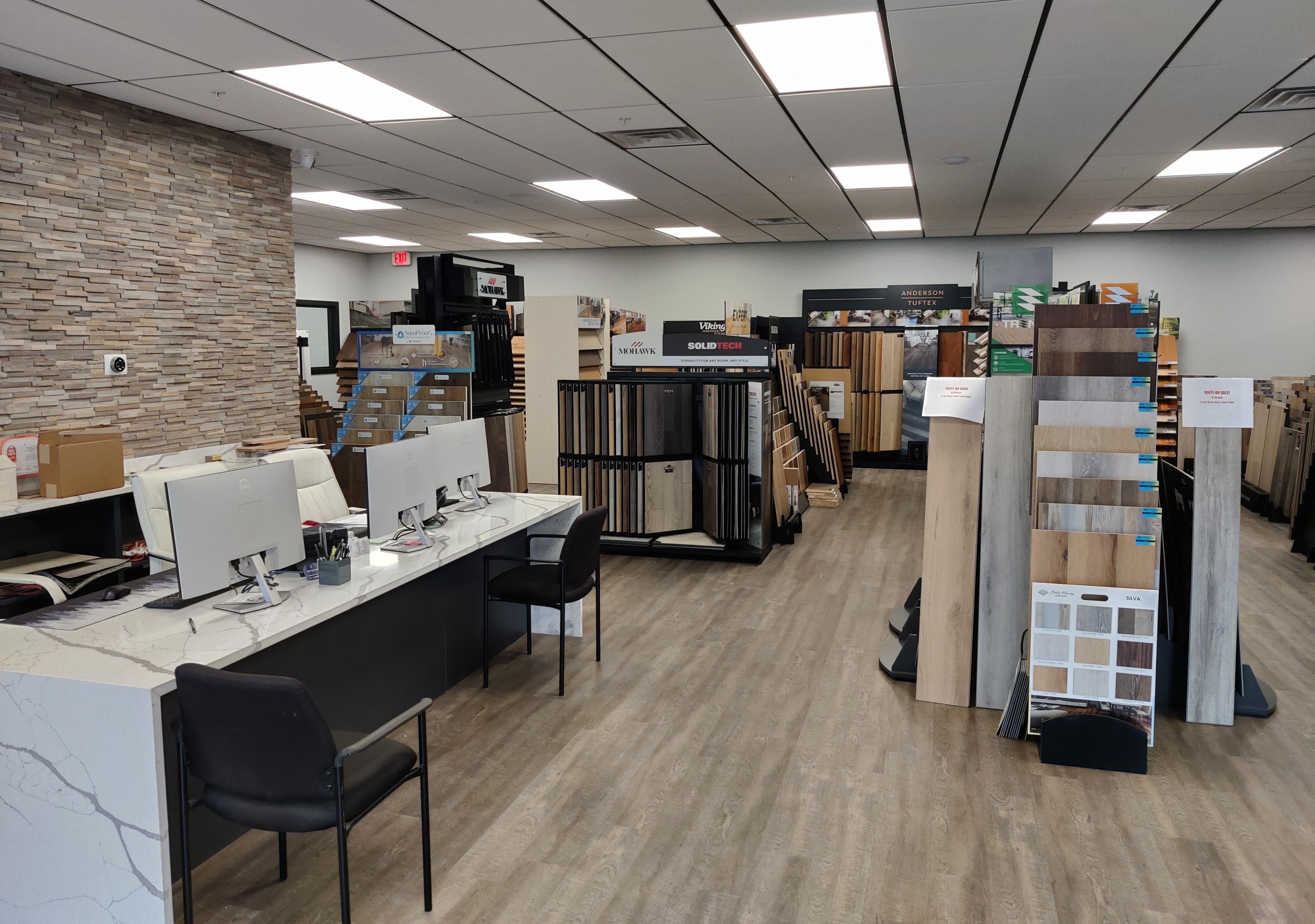
Radiant heat and flooring compatibility is one of those decisions where the specific details change the answer significantly. The type of radiant system, the subfloor construction, the room's heat load, and the specific laminate product all interact, and a general article can map the territory but cannot substitute for a conversation about your actual project.
The Creative Floors INC showroom in Aurora carries flooring options across laminate, SPC-core LVP, and engineered hardwood, including products that have been tested and warranted for radiant heat applications. The team there can review your system type and operating specifications against the warranty requirements for any product you are considering, which prevents the frustrating situation of discovering a compatibility issue after the floor is already down.
Visit Creative Floors INC or stop by the Aurora showroom. Bring the brand and model of your radiant system, or a photo of the thermostat and any system documentation you have. That information narrows the product selection considerably and makes the conversation more useful from the first minute.