Key Takeaways
- Laminate with an AC4 or AC5 wear layer resists fine surface scratches from dog claws better than most entry-level engineered hardwood, but it cannot be sanded or refinished when the wear layer eventually degrades.
- Engineered hardwood loses the initial scratch battle on soft finishes, but wins the long-term value argument: a quality product can be lightly refinished two to four times over its lifespan, which matters in a household with large, active dogs.
- In the Aurora and Fox Valley climate, laminate edges out engineered hardwood on humidity tolerance, especially in homes with inconsistent HVAC use or a history of basement moisture, since laminate cores are more dimensionally stable across the wide humidity swings of an Illinois year.
- Finish texture matters as much as material: wire-brushed and hand-scraped profiles on either product hide everyday claw marks far better than smooth, high-gloss surfaces, regardless of whether the board is laminate or engineered wood.
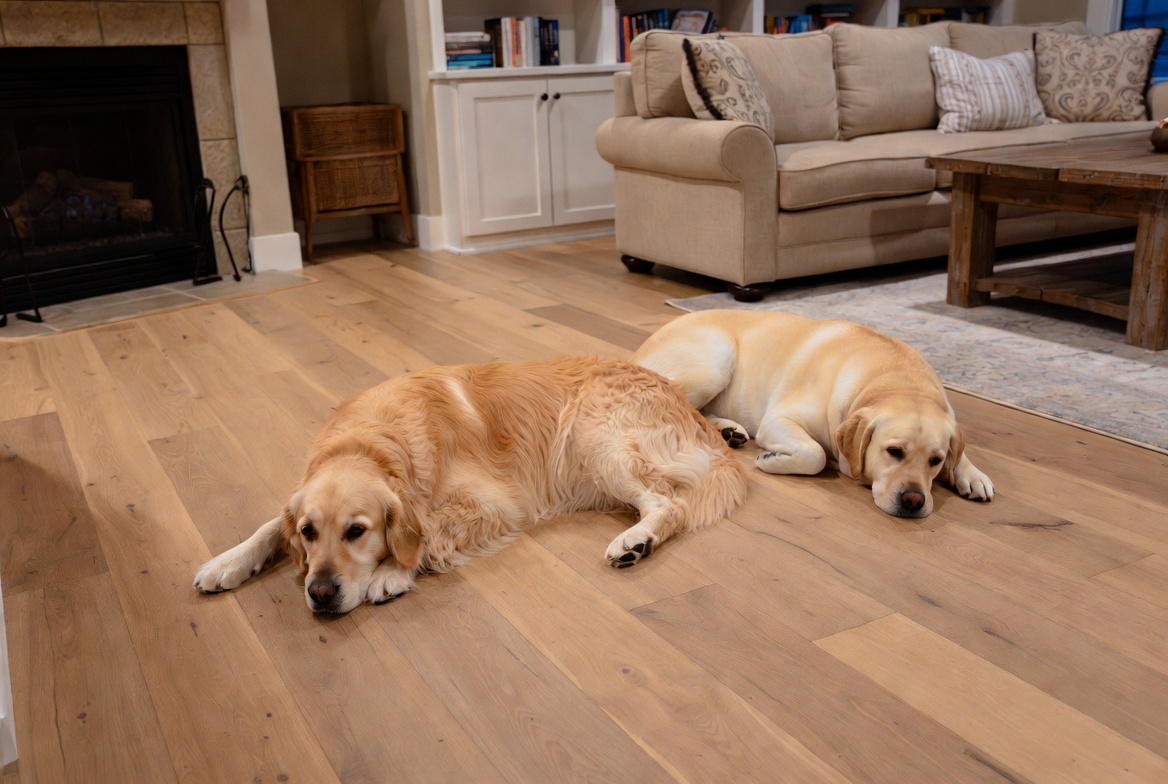
What actually happens to a floor when a large dog walks across it?
A 70-pound Lab or a 90-pound German Shepherd generates real point pressure with each step. When nails are long and overgrown, the contact point is a narrow claw tip rather than a broad paw pad. That tip drags slightly across the surface with each stride, creating fine linear scratches in the direction of travel.
On a smooth, high-gloss floor, those scratches catch light and are immediately visible. On a matte or textured surface, the light scatters across the grain instead of reflecting cleanly, which makes the same damage much harder to see. This is why the finish profile of your floor, glossy versus matte, wire-brushed versus smooth, often determines how a dog household perceives their floor's condition more than the actual material does.
Beyond scratching, large dogs also contribute moisture (drool, wet paws from rain or snow, water bowl splashes) and grit (tracked-in road salt from November through March, sand, and dried mud). A flooring choice in the Fox Valley area has to account for all of that, not just the claws.
How does laminate resist dog claw damage, and what are its limits?
Laminate flooring is built with a hard aluminum oxide wear layer bonded over a photographic image layer, all sitting on a high-density fiberboard (HDF) core. The wear layer is rated using the AC system, from AC1 (light residential) through AC5 (heavy commercial). For a household with large dogs, AC4 is a reasonable baseline, and AC5 provides additional margin.
That aluminum oxide surface is genuinely hard. Most claw tips will skid across it without penetrating, which is why laminate often looks cleaner than engineered hardwood after a year of heavy dog traffic. The scratches are shallower because the wear layer is harder than most factory-applied wood finishes.
The limits become visible over time. Laminate cannot be sanded or refinished. Once the wear layer is breached, the photographic image layer underneath is exposed, and no amount of polishing recovers that section. The repair option is plank replacement, not floor renewal. In high-traffic dog corridors, such as the path from back door to water bowl, wear layer degradation tends to concentrate in predictable lines.
The other limit is water. Laminate's HDF core is vulnerable to prolonged moisture exposure. Drool pooling around a water bowl, wet paw prints that sit for hours, or a dog that shakes off after rain can push moisture into seams over time. The surface resists short exposure well, but a dog household that is not diligent about wiping up will eventually see edge-swelling or seam separation in the worst-affected spots.
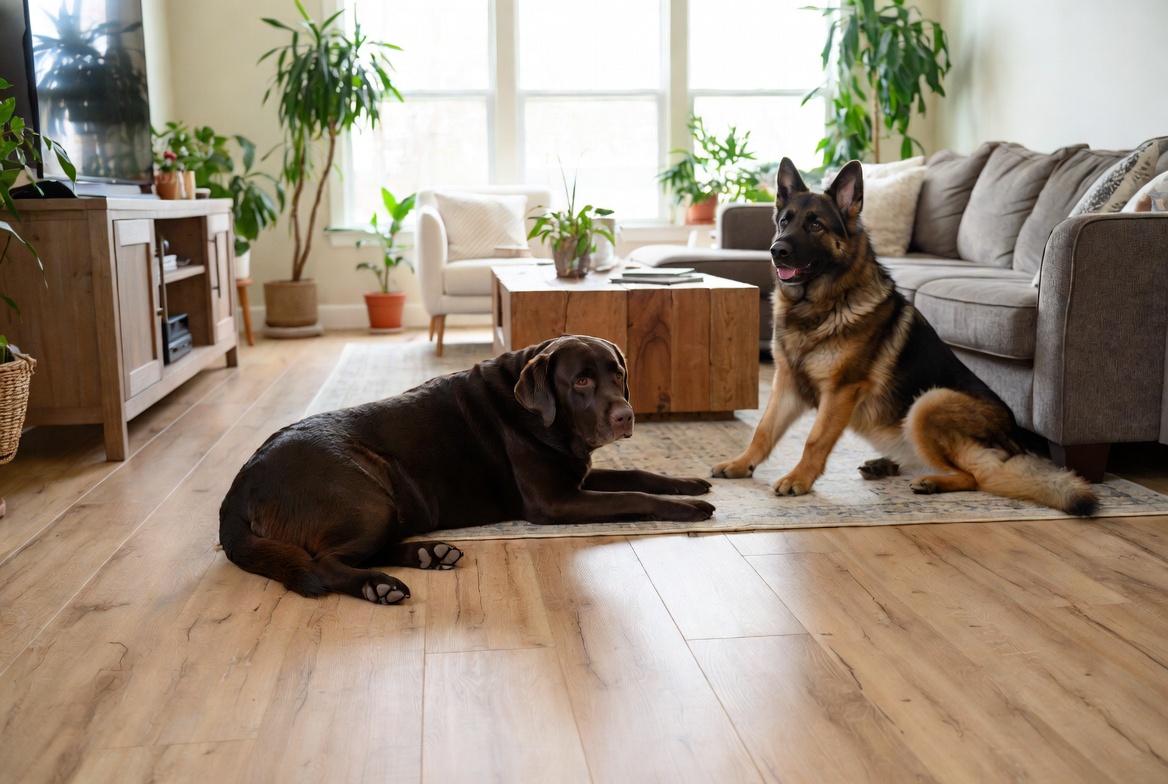
How does engineered hardwood handle dog claws differently?
Engineered hardwood is a real wood veneer (typically 2 to 6 millimeters thick) bonded over a cross-ply plywood or HDF core. The factory finish over that veneer is polyurethane-based, often with aluminum oxide additives, but it is generally softer than a premium laminate wear layer at the same price point.
What engineered hardwood offers instead is repairability. When fine claw scratches accumulate over several years, a refinishing contractor can lightly sand the surface and apply a fresh coat of finish. Depending on the veneer thickness, this can be done two to four times over the floor's life. That changes the long-term math significantly: a scratch that would require plank replacement in laminate can be screened and recoated in engineered hardwood.
The finish choice on engineered hardwood also matters considerably for dog households. A matte, wire-brushed, or hand-scraped surface profile scatters light across the grain and makes fine scratches nearly invisible in daily life. A smooth, satin-gloss finish on the same wood species will show every mark within weeks of a large dog moving in.
Engineered hardwood is also warmer underfoot than laminate, which is worth noting for older large-breed dogs that spend significant time lying on the floor. The difference is not dramatic, but it is measurable, and for a 10-year-old German Shepherd with joint issues, a floor that holds ambient temperature better than a thin laminate layer is a minor but real consideration.
Head-to-Head Comparison: Laminate vs. Engineered Hardwood for Large Dog Households
The table below compares both products across the factors most relevant to Aurora-area homeowners with large dogs. Ratings reflect general product-category performance at comparable mid-range quality tiers.
| Performance Factor | Laminate | Engineered Hardwood | Advantage |
|---|---|---|---|
|
Surface Scratch Resistance |
High: AC4-AC5 aluminum oxide wear layer deflects fine claw marks reliably |
Moderate: factory finish resists scuffs; deeper scratches can reach wood fibers |
Laminate |
|
Deep Gouge Recovery |
Limited: filler kits mask damage but planks cannot be sanded; replacement is the repair |
Good: a worn-through wear layer can be lightly sanded and refinished 2-4 times over the floor's life |
Engineered Hardwood |
|
Claw-Click Noise |
Moderate to high: hollow core amplifies the tap of dog nails, especially without thick underlayment |
Low: denser construction absorbs sound; quieter underfoot for dog and owner alike |
Engineered Hardwood |
|
Water & Drool Resistance |
Excellent (AC4+): water-resistant surface handles spills and slobber with prompt cleanup |
Good: resists surface moisture but seams need prompt drying to avoid swelling at edges |
Laminate |
|
Illinois Humidity Tolerance |
Excellent: core materials are dimensionally stable through Fox Valley humidity swings |
Good: engineered cross-ply construction manages seasonal movement better than solid wood |
Laminate (slight) |
|
Road Salt & Mud Tracking |
Very good: hard surface cleans easily; gritty particles do not embed in wear layer |
Good: finish withstands grit with regular sweeping; avoid prolonged wet mopping |
Laminate (slight) |
|
Comfort for Dog Joints |
Moderate: thin profile can feel hard; quality underlayment improves cushion noticeably |
Better: denser wood construction is warmer and marginally softer underfoot for aging dogs |
Engineered Hardwood |
|
Long-Term Longevity |
10-20 years with proper care; wear layer eventually degrades and cannot be renewed |
25-50+ years with one or two refinishes |
Engineered Hardwood |
|
Visual Hide of Scratches |
Wire-brushed or distressed textures hide everyday claw marks well |
Matte and wire-brushed finishes perform similarly; hand-scraped profiles mask wear effectively |
Tie (finish-dependent) |
Note: Performance ratings reflect mid-range products in each category. Budget laminate (AC1-AC2) and budget engineered hardwood with thin veneer layers will underperform these generalizations. Installation quality and subfloor condition also affect real-world results.
How does the Aurora, IL climate factor into this decision for dog owners?
Anyone who has lived in the Fox Valley area for a full year knows the humidity story. July and August bring genuine mugginess that can push indoor relative humidity past 60 to 70 percent in homes without aggressive air conditioning. January and February, with forced-air furnaces running constantly, drop indoor humidity to 20 percent or lower. That is a 50-point swing or more across a single year.
For flooring, that swing matters because wood moves with moisture. Solid hardwood moves the most. Engineered hardwood, with its cross-ply core, moves significantly less. Laminate, depending on core formulation, tends to be the most dimensionally stable of the three.
For a dog household specifically, this climate reality intersects with the moisture a dog introduces. A dog coming in from a July rainstorm adds both tracked water and ambient humidity to the room. A dog coming in from a February walk shakes off road-salt-laced snow melt. Laminate tolerates the short-term surface moisture better, but any flooring product needs the seams wiped within a reasonable time frame.
Homes in Aurora's older subdivisions, particularly those with crawl spaces or unfinished basements, also need to account for moisture from below. Subfloor moisture levels should be tested before any flooring installation, and a vapor barrier or appropriate underlayment is not optional in those situations regardless of whether the product is laminate or engineered hardwood.
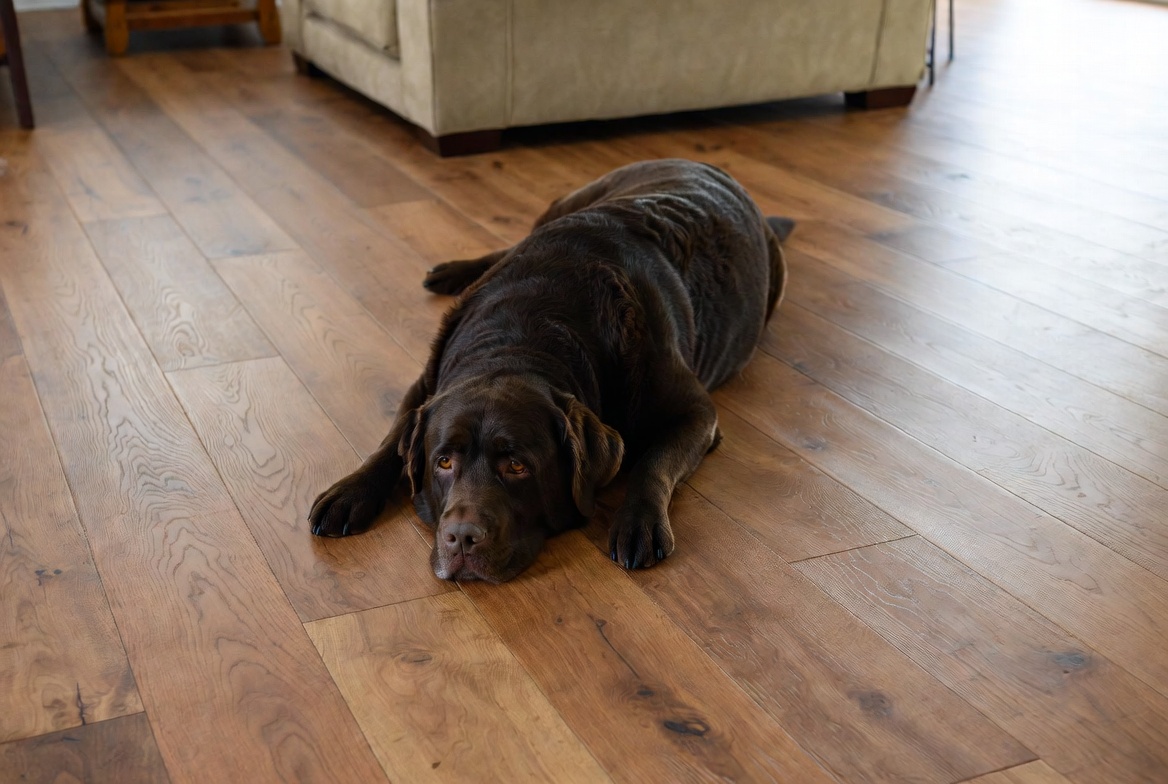
Does the Aurora housing market affect which flooring choice makes more sense?
Aurora's real estate inventory has been running lean, with roughly 1.4 months of supply and homes moving to pending status in around 16 days on average. In that environment, flooring is one of the few interior updates that genuinely shows in listing photography and resonates with buyers during showings.
From a resale standpoint, engineered hardwood in a current finish tone tends to photograph better and is perceived by buyers as a higher-value upgrade than laminate at a comparable price point. That perception is not always accurate on a technical basis, but it exists in the market and influences offer prices.
For a homeowner who plans to stay in their Aurora home for 15 or more years, the refinishing advantage of engineered hardwood becomes more concrete: the floor can be freshened at year 10 or 12 rather than replaced entirely, which reduces the lifetime cost of ownership. For a homeowner planning to sell within three to five years, a well-chosen, properly installed laminate product in a current tone can be a sensible, cost-effective way to update the floor before listing.
What practical steps reduce claw damage on either floor type?
A consistent routine matters more than the material choice alone:
- Keep dog nails trimmed or ground on a regular schedule. A nail that extends 2 mm past the paw pad creates significantly more floor contact than a nail kept short. Most groomers recommend a trim every 3 to 4 weeks for active large-breed dogs.
- Place area rugs or runners along high-traffic dog corridors: the path from back door to food and water station, the space in front of a favorite resting spot, and any hallway the dog uses repeatedly. Rugs protect the floor and give the dog better traction.
- Use a rubber-backed mat under the water bowl. Water bowl splashes are a leading cause of seam moisture damage in both laminate and engineered hardwood, and a mat catches the splash before it reaches the floor.
- Wipe paws at the door, particularly during winter months when road salt, sand, and ice-melt products come in on paws. Salt and grit are abrasive on any floor finish and accelerate fine scratching at entry zones.
- For laminate, use a dry microfiber mop daily and a damp mop with a laminate-safe cleaner weekly. Avoid steam mops on either product: the heat and trapped moisture damages both the surface finish and the core layer over time.
Are there specific product features to look for when shopping with a large dog in mind?
For laminate, the wear layer rating is the starting point. AC4 is the minimum worth considering for a large dog household. AC5 provides additional durability and is worth the modest step up in cost for high-traffic rooms. Beyond the rating, look for:
- A core thickness of 10 mm or 12 mm rather than 7 or 8 mm. Thicker cores absorb sound better, which reduces the claw-click noise that many dog owners find annoying, and they feel more solid underfoot.
- A water-resistant or waterproof core (often labeled WPC or SPC). These formulations tolerate moisture at the seam level better than standard HDF cores and are worth prioritizing for dog households.
- A wire-brushed, embossed, or hand-scraped surface texture. These profiles hide fine claw marks and are more forgiving of everyday wear in a dog home.
For engineered hardwood, refinishing potential depends on the thickness of the real wood wear layer (the top veneer). Floors with a 2 mm wear layer can usually be lightly sanded once or twice. Those with a thicker 4 to 6 mm wear layer support two to four refinishing cycles over time. Look for:
- A veneer thickness of at least 3 mm if refinishing over the floor's life is part of the plan.
- A matte or satin finish with a wire-brushed or distressed surface profile. Smooth, high-gloss finishes are not practical for large dog households.
- A species with a higher Janka hardness rating. White oak, hickory, and maple are more resistant to denting and deep scratching than softer species like pine or lower-grade oak. Honey oak finishes applied to harder species give both the warm tone and better durability.
- A factory finish that uses aluminum oxide additives in the polyurethane, which improves scratch resistance at the surface level without changing the repairability of the veneer below.
Which product is the stronger overall choice for a large dog household?
There is no single answer that fits every household, but the decision generally comes down to two variables: how many years you see yourself living there, and how much floor maintenance you are willing to do.
If you have one or two large, active dogs, plan to be in the home for 15 or more years, and want a floor that can be refreshed rather than replaced at the 10-year mark, engineered hardwood in a matte, wire-brushed finish is the stronger long-term choice. The initial scratch tolerance is lower than premium laminate, but the refinishing option changes the total cost picture over time.
If you have multiple large dogs, a household with significant moisture tracking (a dog that swims, works outdoors, or comes in wet frequently), or plan to sell within five years, a quality AC4 or AC5 laminate with a waterproof core and a textured surface profile is a durable, practical selection. It requires no refinishing, tolerates moisture at the surface level, and presents well in listing photos when chosen in a current warm-neutral or honey tone.
In either case, the finish profile and installation quality matter as much as the material category. A wire-brushed engineered oak in a honey or blonde tone installed over a properly prepared, dry subfloor will outperform a poorly installed, smooth-finish laminate regardless of wear layer rating.
See Both Options in Person at Creative Floors INC in Aurora
Reading about wear layers and veneer thickness only goes so far. The most useful thing a dog-owning homeowner can do before making this decision is walk across both products in a showroom setting, look at them under different lighting conditions, and run a fingernail across the surface to get a real sense of how each finish feels and resists contact.
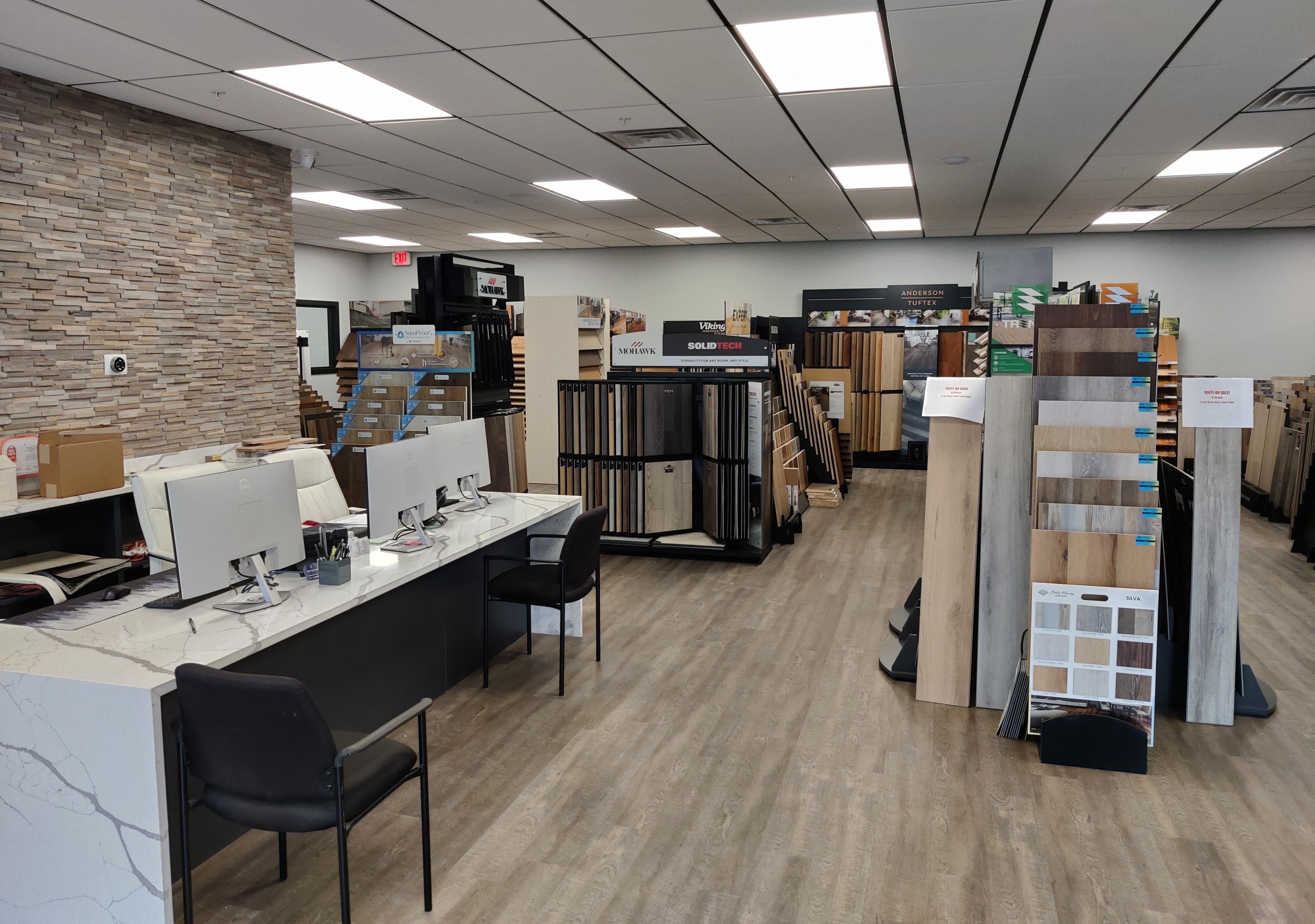
The Creative Floors INC showroom in Aurora carries a range of laminate and engineered hardwood products across multiple price tiers, including options in the warm-neutral honey and blonde tones that align with current 2026 Fox Valley design preferences. The team there can also walk you through subfloor preparation requirements specific to Aurora-area home construction, moisture testing, and installation approaches that make a meaningful difference in how long either product holds up in a working household.
Visit Creative Floors INC at creativefloors.co/m/ or stop by the Aurora showroom. Bring the dimensions of your room and, if you have it, a photo of your current floor. Mention that you have large dogs. That context helps narrow the options to products that will actually perform in your home rather than just look good on a sample board.